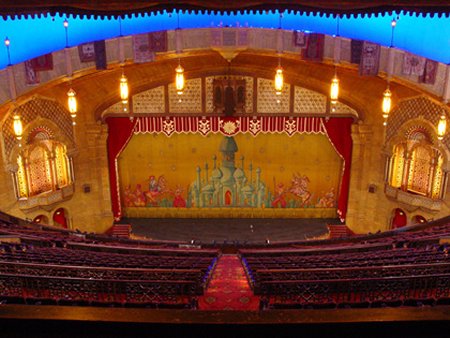
End on/ Proscenium arch: It is the most common of all the staging types because it has huge benefits and supports most types of work without hindering viewpoints. The audience sits on one side facing the action straight on. On most west end stages this is used because in my opinion it is a beautiful picture frame to look at framing the artwork on stage giving 100% of your focus forward towards the stage taking you out of your seat and on a wonderful journey. All the whole proscenium arch provides a way of helping bounce the sound around the entire stage space encompassing the audience in an orgy sounds and I also find the arch golden and beautiful to look at to be honest I'm mean look at it! It's art!
fuel you and you just move through this space which can also help to advance the scene. Specifically molded pieces of physical theatre like the ones that were demonstrated in our workshops. We can also connect with the audience on a more personal level with intimacy and audience involvement.
 Traverse: Not to be bias or anything but... this is my favourite, simply because it's like a Theatre equivalent to a catwalk combining the immersiveness of in the round but the separation of art and audience like end on. There's so many things to play around with especially with what you show the audience. There's tons of room to play around with behind, in front on the main stage, at either end and even in the actual audience. You can be vulnerable and intimate one moment and then closed off and hidden the next. Going back to the point of audience placement you can play with their emotions by making the person opposite them visible to them psychologically changing the way they react to certain things! You make it seem like you have a minuscule amount of space in this long strip but in fact really you have giant space to play, you've just got to learn to find it!
Thrust: This is also known as a platform stage or open stage, it extends into the audience on three different sides creating a sort of apron. This has the benefits of the end on stage but with the overall intimacy slightly increased. This one has a lot of cool features that can be really useful in most performances but I just find it slightly obligatory, other staging types over-shadow this one, it tries to be too many different things at once when others offer a bigger way of doing this if you see what I mean? You have things like being able to enter and exit through the audience giving them a much better view!
Immersive: This is a quite rare staging type, I guess because (on it's own) it can either work amazingly absolutely capturing it's audience or take away all the mystery and wonder there is in theatre. If you want to make the audience step into the world of the character 100% with nothing to hide than this would be the one to use. If you want the audience to feel the cold breath down their backs or the screams in their ears than this would be the one to use. In my opinion this should be combined with another theatrical configuration to give it watering down.


Sexist Freudian misnomers "THRUST" & "FORESTAGE" must be dropped from theatre because:
ReplyDelete1. OED dates these terms to c.1890, at their earliest. Theatre professionals started speaking these new sexist Freudian misnomers ONLY after the Private Lord Chamberlain achieved Parliament's approval to ENFORCE were invented to coincide with the ENFORCEMENT of the masonry proscenium arch (with iron curtain) on the specious grounds of "fire protection." Theatres, like Exeter's Theatre Royal, burned to the ground a SECOND time AFTER new local Councils started enforcing its new so-called "Fire Protection" masonry proscenium arch & iron curtain.
2. This sexism BLINDS readers to the purpose of these distinct types of stages: the audience surround them on three sides. NOT in-the-round; NOT all facing the front; NOT semi-circular. ON THREE SIDES, even with most of the audience to the front.
ReplyDelete3. Audiences who embrace performers on three sides of the main acting area floor HEIGHTEN the ENERGY in well-directed professional play performances. This is evident in the WILD explosion of energy from audiences as pop stars WALK FORWARD onto new B-Stages where their fans embrace them ON THREE SIDES! This immediate HEIGHTENING OF ENERGY is palpable (in YouTube and other video-recordings) as the fans' screams rapidly increase louder and their behaviours become significantly more fanatically frantic.
4. They blind us to the possible likelihood of women pretending to be men who might - MIGHT - have acted plays professionally alongside Shakespeare. How many of Shakespeare's known actors fathered children? Is it possible (likely?) that these actors MIGHT have been women?
ReplyDelete5. Forestage & Thrust Stage blind us to the historical FACT that some women in history DID pretend to be men to (a) join the British Army; (b) join the British Navy; (c) work professionally; (d) become Pirates... and more and more professional work. Historians KNOW women did this in the 18th and 19th centuries and it's unreasonable to presume NO WOMEN might have done this in Shakespeare's time....
ReplyDelete6. The English stage NEVER "developed" from Shakespeare's ENORMOUSLY DEEP "Thrust" to the shorter "Forestage" when "women & scenery" were supposedly "added by men," c.1661. This SEXIST myth WRONGLY sees the English stage as a penis, harmed and reduced by "women and scenery added to the stage."
ReplyDelete7. Women have NEVER been objects, like scenery. Theatre historians who have insisted on Theatre students seeing women as " added scenery" must now STOP. STOPPING this sexism also STOPS us seeing the English stage as a "thrusting" penis. Stopping this sexism allows everyone to see English theatres throughout history as audiences surrounding performers ON THREE SIDES to watch plays because this is the best way to heighten energies in play performances.
ReplyDelete